

Explore Our Research
(Click on any research topic to learn more)
Copper Nanoclusters
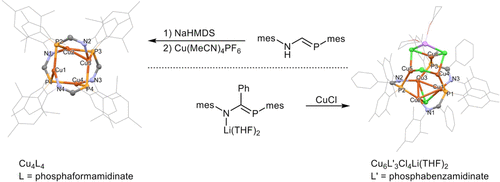
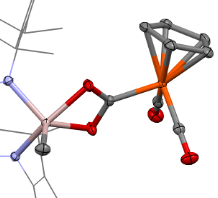
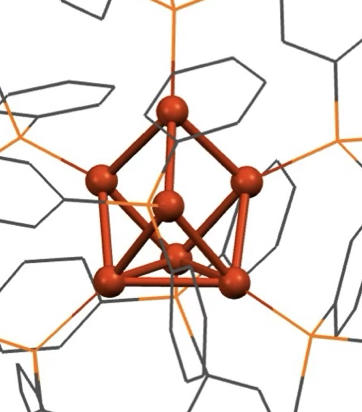
Transforming carbon dioxide into liquid fuels or valuable chemical feedstocks is a central challenge in sustainable chemistry. Copper-based materials are among the most promising catalysts for this purpose, uniquely capable of converting CO₂ into C₂+ products during electrochemical reduction. However, understanding how these reactions occur on copper surfaces remains difficult, because the active sites of heterogeneous catalysts are often structurally ambiguous. Our group addresses this challenge using atomically precise nanoclusters (APNCs) of copper. These well-defined molecular species serve as models for sections of catalyst surfaces and subsurfaces, allowing us to probe structure–function relationships with high resolution. This project combines our group’s expertise in metal cluster synthesis with synchrotron-based advanced crystallography measurements.
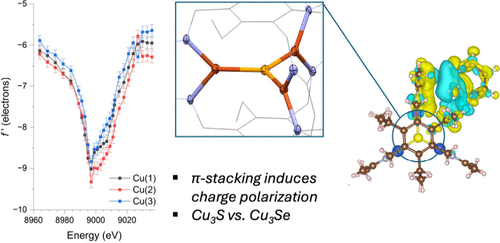
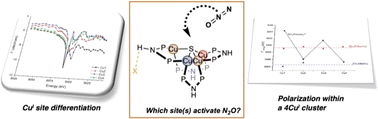
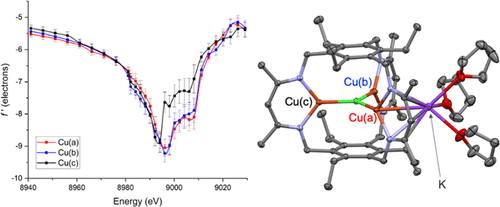
We employ resonant X-ray diffraction anomalous fine structure (DAFS) to examine the local electronic environments of individual Cu atoms within APNCs. Our long-term goal is to spatially map electron distributions in these clusters and understand how geometry, ligand binding, and heterometal doping influence their properties.
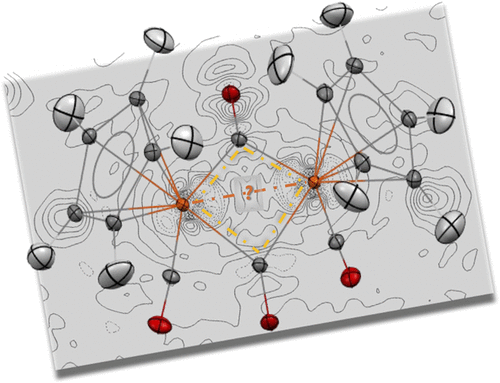
In parallel, we use high-resolution charge density (HRCD) analysis—also known as quantum crystallography—to investigate the intermetallic regions between Cu atoms. This technique enables us to study subtle, non-covalent interactions between copper atoms, including so-called cuprophilic bonding, and to determine how these interactions are shaped by structural context.
Together, these approaches provide atomic-level insights that bridge the gap between molecular and materials chemistry—helping to illuminate the reactive landscape of copper-based catalysts from nanoclusters to bulk materials.
Currently, these projects are funded by NSF grant CHE-2451851.
Accepting new researchers:
Not accepting new researchers: